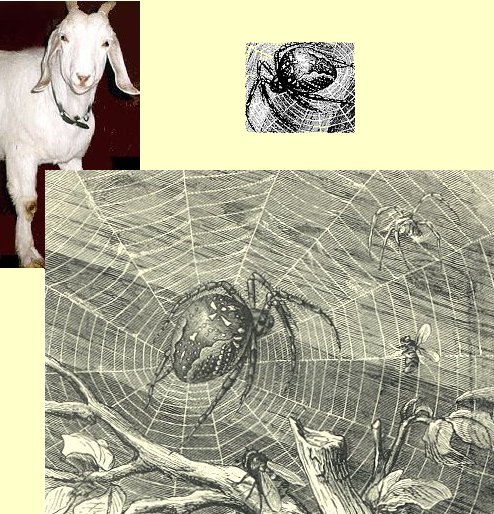
Spider Goats?
Click for scary background sound in a new window (.WAV file)
I never would have believed it unless I had read it myself. Scientists have successfully genetically altered a goats embryo with the DNA of a spider. These genetically altered goats produced (mutated) in a laboratory are presently producing milk that is being used to make bullet-proof vests. The fibers contained in the spider goat's milk are twice as strong as Kevlar!!! Can you imagine?
Though it may seem like a noble invention to save people's lives, the implications of such monstrosities is greatly disturbing. What else can scientists create? Let your imagination run wild and you'll be convinced as I am that the end of the world cannot be far away. If you are wondering if scientists are tampering with human embryos, the answer is horrifyingly "yes." Mankind is savage! Do you think that AIDS just happened, never having existed before until the 1980's? Think again! AIDS is the creation of the U.S. military. A weapon designed to curb the earth's population. If I'm scaring you...GOOD! We need to be scared, scared enough to fall on our knees and beg God to bring revival to churches across America.
What else are scientist's messing with? Will we see people with six legs like an insect? Will we see people that can climb trees like a cat? Will we see men with armor-plated skin like the armadillo? Will we see people that glow in the dark like fireflies? Don't laugh, the frightening possibilities are endless. What genetic monstrosities will the military try to develop? I saw a movie called "The Island of Dr. Moreau" when I was a child about a mad scientist who lived on an abandoned island and had successfully produced multitudes of mutated half animal/half human creatures. I never thought I'd live to see the day when that would become a frightening reality.
Eight-legged Biotech Revolution Bred in Goats
By Peter McMahon | June 19, 2000

Growing larger amounts of silk in goats than spiders allow has made the new natural building material a possibility. A few years from now your car could be biodegradable, your plane ticket could cost less and your complicated nerve injury could be repaired - all thanks to an idea that came from a spider web. The idea of reproducing the enormous tensile strength of spider silk has been around for years, but it has always been impossible to get the spiders to produce enough of the material themselves. Now a Montreal-based bio-tech company has come up with a plan to breed the spider's silk-producing gene into Nigerian dwarf goats in order to mass produce the silk in a larger, more docile host.

This U.S. military base in New York will be converted for the Montreal company's research. Tomorrow, scientists from Nexia Biotechnologies Inc. will move about 150 specially-bred goats to their new home on a former military base in New York State. They hope the new material the goats will help produce there - named BioSteel - will soon be available as a stronger, more lightweight, environmentally friendly alternative to polymers like Kevlar or Polypropylene. This new material is the same 'frame' or 'drag line' silk that spiders use to dangle from above or build the framework for their intricate webs.
Once refined into fibres, this material could be used in automotive or aerospace components, as a high tensile strength suture for nerve repair, in prosthetic devices and even for stronger, lighter bulletproof vests for law enforcement.
"Spider drag line silk is the Holy Grail of material sciences. It's been widely recognized as the strongest material known to man," says Dr. Jeffrey Turner, Nexia's president and CEO. "When you grab a spider web, you can actually feel the tenacity of those filaments."
Generally, a high-performance artificial fibre is made up of a group of thin filaments wound together that are each about the same diameter as spider silk. Each individual BioSteel fibre - which looks like a thread - is made up of 100 to 500 filaments. Each filament itself isn't very much, but wound by the hundreds into fibres, which are then wound into a solid material by the millions, creates what Turner says will be the strongest building material ever.

Goats at the facility will carry the spider silk in their milk before it's skimmed off for processing into BioSteel. Essentially, the team is assembling complex biological material (liquid crystal made out of silk proteins) from the spiders the same way synthetic filaments are interwoven to make Kevlar and other materials. "The end result is almost identical, but the way that the spider goes about doing it - or has evolved into doing over the past 400 million years - allows you to achieve much higher levels of performance," says Turner. "The spider silk is quite a bit stronger than anything man can make."
Turner says Nexia scientists start by putting a single highly characterized gene into a goat egg cell through a tiny glass pipette. About five per cent of the time, a spider silk gene becomes part of one of the goat chromosomes.
"The result is that you have 70,000 goat genes and one spider gene," he says. "That's the reason why the goat doesn't start to look like a spider. It's very diluted so the change is only in the goat's mammary gland and the silk is eventually exported."
After the egg is transplanted back into a foster mother, the goat is born with the gene that produces milk with spider silk in it. The goat is milked and the silk is then skimmed off with conventional dairy technology and spun into filament. "We're using these goats the same way they've been for the past 8,000 years," says Turner. "We've just discovered that these animals can convert hay, water and corn into a material that can be used in medicine and industry as well as for food.

BioSteel spider-silk filaments like this are less than a micron in diameter. Turner says BioSteel will be useful in aerospace where weight is at a premium and parts need to be as strong as possible. "Also, there are a myriad of healthcare applications that could benefit from this. If you look at wound-closure systems, very fine sutures are hard to come by."
Though it may be a few years before any companies have such a material ready for consumer use, Turner says Nexia is aiming to have basic products like ultra-strong fishing line ready in a year or two. More complex applications for medicine and industry could be available in five to make many of the products we use more accessible and less damaging to the environment.
"Hundreds of millions of pounds of these artificial polymers are going to be in the eco-system for a long time," says Turner. "On the other hand, take a walk in a forest and you don't see three feet of spider silk piling up. The manufacture of spider silk and the product life has a very low environmental footprint, as opposed to Kevlar or Polypropylene. The impact of this technology is going to be global if we can really get back to mother nature and leave these polymers behind."
END

This will be every transgenic cat's dream, glow in the dark mice. Don't think for one moment that fluorescent humans aren't around the corner, mark my words...you'll see it, along with spider humans and every other godless monstrosity of mad scientists. Man's good intentions are often a Pandora's box. Even so, come Lord Jesus!

AFTER ANOTHER KIND...
The Bible plainly teaches in Genesis 7:14 that God intended for every living thing to reproduce “after his kind.” Genesis 7:14, “They, and every beast AFTER HIS KIND, and all the cattle AFTER THEIR KIND, and every creeping thing that creepeth upon the earth AFTER HIS KIND, and every fowl AFTER HIS KIND, every bird of every sort.” Yet, men in their arrogance and unrestrained curiosity have crossed the line with God, creating mutant species AFTER ANOTHER KIND...
 |
||
 |
|
|
Transgenics: The Coming Genetics Nightmare!


Scientists have recently engineered a genetically modified cow that produces human insulin proteins in its milk, which could potentially address global insulin supply issues for diabetes management. This breakthrough marks the first successful production of human insulin in a transgenic bovine, paving the way for future advancements in insulin production methods. READ MORE
George Soros is Selling Gold to Buy Farm Land
(the
handwriting is
on the wall)